

Why Study Our City?
Thinking Like Missionaries in the Place We Call Home


When the Greater Austin Mission Society was still just an idea at the beginning of 2025, we kept returning to one simple discipline: learning to think like missionaries in our own backyard. It is a strange thing to say about a place you have lived for years. Most of us do not feel like missionaries when we drive the same highways, shop at the same H-E-B, and drop our kids at the same schools we always have. Familiarity has a way of making a place invisible to us. We stop seeing it.
But a missionary cannot afford to stop seeing. When believers carry the gospel into a new culture, the first thing they do is not necessarily preach. It is often to learn. They study the language, the history, the rhythms of daily life, the hopes and fears of the people, and the ways God may already be at work before anyone arrived. Then they know how to love, serve, and speak well in a culture. We have come to believe that Austin now asks the same of us. The city we live in has changed so much, so fast, that loving it well requires us to study it again, as if for the first time.
Asset Mapping and the Posture It Requires
One of the exercises commonly commended when a worker enters a new context is called asset mapping. Rather than starting with everything that is broken or missing, asset mapping begins by taking honest stock of what is already present: the people, the institutions, the histories, and the signs of life that God has placed in a community. It is a posture of attention before action, of gratitude before strategy.
So that is where we started. We asked a deceptively simple question: what kind of information is publicly available that could give us insight into God’s activity across Greater Austin over time? We wanted to understand what was before we set out by faith to build what may be. We are committed to being Spirit-led and data-informed, and we do not think the two are in competition. Data does not replace prayer or discernment. It serves them. Numbers can tell you the shape of a city, but only the Spirit can tell you what to do about it.
There is a quiet humility built into this work. “The heart of man plans his way, but the Lord establishes his steps” (Proverbs 16:9). We gather what we can see precisely because we know how much we cannot. The research is an act of attention, not control. It is us saying to the Lord, in effect, “Show us this city the way You see it, and make us willing to go where You are already moving.”
What We Set Out to Learn
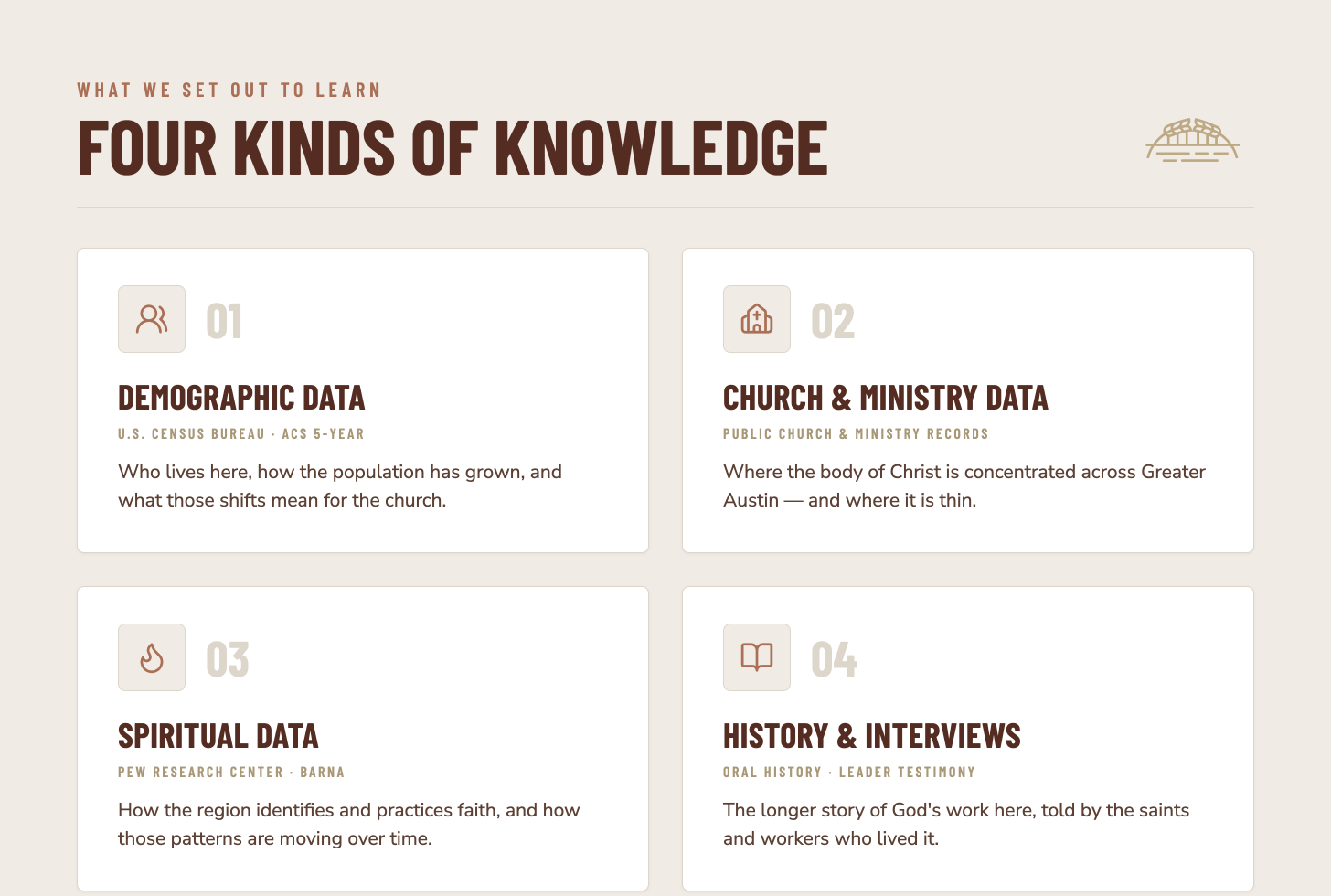
Over the months that followed, our study took shape around four kinds of knowledge, and they form the backbone of the series you are beginning to read.
The first is demographic data. Using the United States Census Bureau’s American Community Survey five-year estimates, we examined the basic facts about who lives here: how the population has grown, how its makeup has changed, and what those shifts mean for the church. Austin is not the city it was even ten years ago, and the numbers make that undeniable.
The second is church and ministry data. This is the work closest to our own hands. We have been building a picture of the congregations and ministries across our region, their theological and denominational makeup, and their distribution across the distinct communities that make up Greater Austin. This lets us begin to see, however imperfectly, where the body of Christ is concentrated and where it is lacking.
The third is spiritual data. Drawing on organizations such as the Pew Research Center and Barna, we have tracked how people in this region identify spiritually, whether and how they practice any faith, and how those patterns have shifted over time. This is where the deepest story lives, because identification and practice are not the same thing, and the gap between them tells us a great deal.
The fourth is history and interviews. Data sits on top of stories. Over time, we want to enrich what the numbers say with the longer history of God’s work in this region and the testimony of leaders, saints, and cross-cultural workers who have seen things no spreadsheet can capture. That work will unfold across the life of this newsletter.
A Word About How We Hold the Numbers
Before we go further, a confession about the limits of what follows. Our church data comes largely from analyzing publicly available information, much of it from individual church websites. It is subject to error. The spiritual data carries meaningful margins of error, sometimes seven to nine points at the metro level. We will try to be honest about that throughout, and we will tell you where a number is firm and where it is a careful estimate.
We also want to resist two temptations that data tends to provoke. The first is despair, the sense that the trends are so heavy that nothing can be done. The second is triumphalism, the sense that if we just had the right plan, the city would turn. Neither is the posture of a missionary. The missionary looks squarely at a hard field and gets to work anyway because the field belongs to the Lord of the harvest, not to us.
Where We Are Going
Over the next several posts, we will walk through what we found, one piece at a time. We will look at how Austin has grown and changed. We will lay out the church map and what it suggests about gospel saturation. We will sit with the spiritual landscape and the slow erosion of practicing faith. We will compare Austin to the cities most like it, which may surprise you.
And then we will ask the only question that finally matters: so what? What is this data asking of the church in Austin, and of us?
I am glad you are here for it. As you read, would you do three things? Pray for eyes to see this city as God sees it. Share these letters with one person who loves Austin. And if you have not yet, subscribe, so the rest of the series finds its way to you.
More soon!