

On the morning of October 15, two emails arrived within minutes of each other. The first came from the Austin Bridge Builders Alliance, a ministry that had spent more than two decades connecting Christian leaders across business, church, nonprofit, and public life in Central Texas. With the unanimous support of its board, the letter said, ABBA would wind down its independent operations the next day and transfer its programs, its intellectual capital, and its financial assets to the Austin Center for Faith and Work.
The second came from the Center’s executive director, Steve Teng, who called ABBA a gift and wrote simply, “We are humbled.”
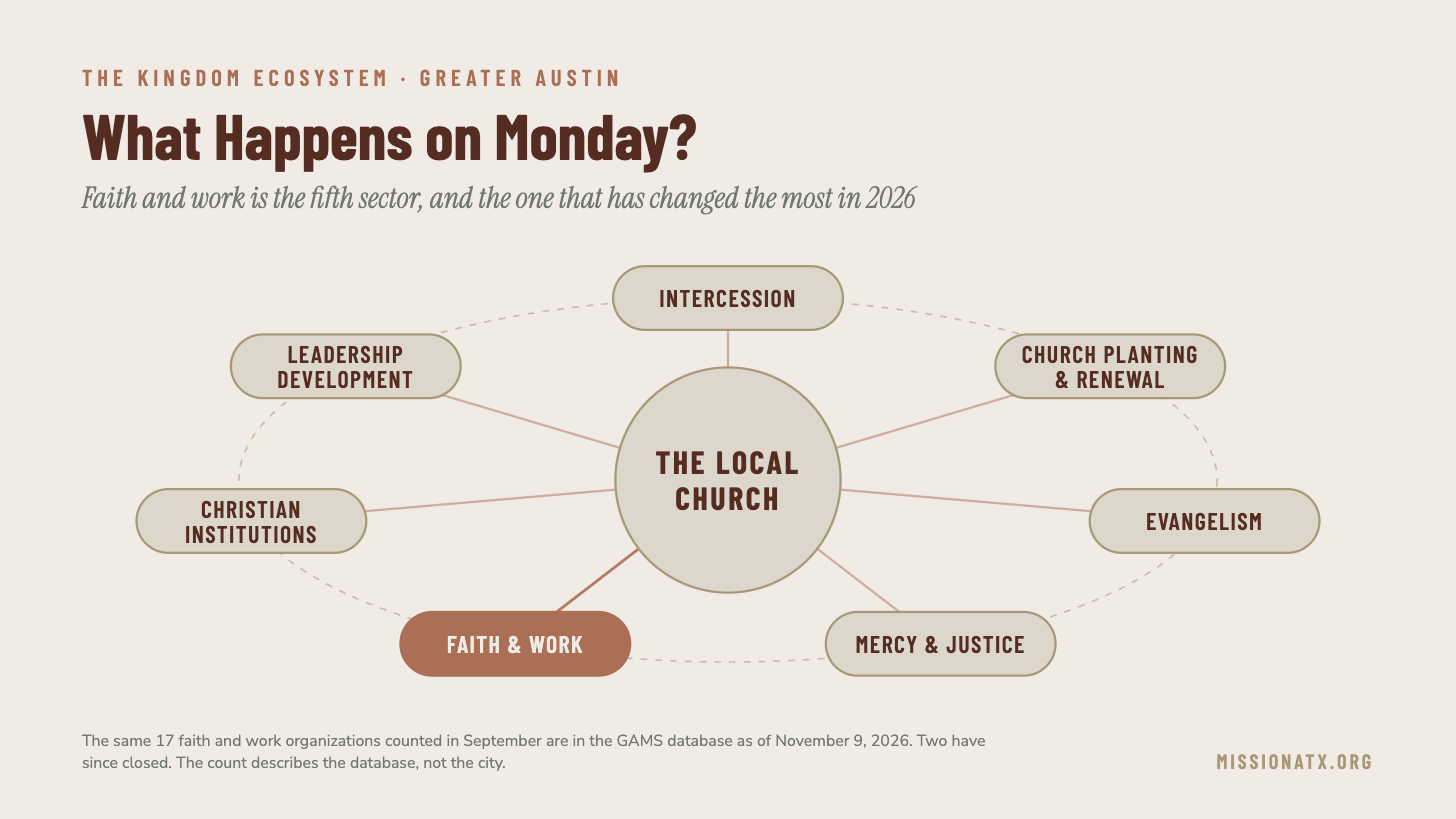
We think that morning tells the story of this whole sector in Greater Austin. Faith and work is the fifth ring on the wheel we’ve been following, and it is the one that has changed the most in 2026. One of its oldest institutions has chosen to end so that another could grow. The sector’s leaders have spent the year asking whether a crowded field could act as one, and, in our experience, some of the most pioneering young leaders in the city are emerging here.
The number of organizations in our database hasn’t moved. The sector has.
What We Mean by Faith and Work
Before there was a church, a mission agency, or a Sunday, there was work. The Lord God put the man in the garden “to work it and keep it,” and the ministries in this sector exist to help the people of God take that calling seriously from Monday through Friday. ABBA’s own farewell describes the aim as well as anyone: “equipping believers to integrate their Sunday faith with their Monday work.”
In our experience, organizations that do this come in two kinds, and much of the confusion about the sector comes from not saying which is which.
Formation ministries disciple believers for faithfulness in the work they already have. They form Christian professionals in prayer, character, theology, and fellowship so that the accountant and the nurse can do their jobs with integrity and see them as a calling. Mission ministries run in the other direction. They mobilize marketplace people, and often marketplace capital, to expand the kingdom, sending business leaders and their resources toward meeting the needs of the city and the world and planting churches.
Most ministries lean one way or the other, and a few try to do both. When a group is hard to file, it is usually because we are asking a formation question of a mission ministry, or the reverse. We’ll use those two words throughout the rest of this essay.
The Data We Have
In the opener to this series, we counted 17 organizations doing faith and work ministry in Greater Austin and said the sector had more forward momentum and change in 2026 than almost any other. Two months later, the number is about the same. A couple of ministries have closed, a couple we had filed elsewhere belong here, and the count still comes to seventeen.
The shape of the count tells you more than the number. Nine of the seventeen are Austin chapters or local presences of regional and national ministries. Three are programs run by local churches. Two are marketplace initiatives, two are networks, and one is an informal movement of friends.
Most of this sector’s organizations belong to something larger than Austin. Very few are local institutions of Austin’s own making, which helps explain why consolidation became the story this year. When many small presences share one city, the question of whether they should keep running separately is bound to come up.
We hold these figures as loosely as ever. The counts describe our database, not the city, and this sector is one where we know the database runs behind reality.
The lines between sectors are blurry, too. A network of Christian executives or a ministry to professionals could be filed under leadership development or evangelism as fairly as under faith and work, and several in our database are.
We can name marketplace ministries and Christian employee groups inside Austin companies that aren’t in the database yet. If you lead one of them, or you know of one we’ve missed, please tell us. We would love to know you.
We’ll also name a blind spot, because the data shows it. Three of the seventeen organizations in our count are programs run by local churches, and we are fairly sure that is a fraction of what exists. Workplace ministries inside congregations rarely have a website of their own or a name that travels, so they are the layer of this sector we know least about.
There is a second set of numbers worth holding next to the first, and it counts people rather than organizations.
About 1.43 million people in the Austin metro go to work. Pew’s most recent Religious Landscape Study found that 26 percent of adults here attend a religious service at least once a month, which is the closest measure we have of a practicing Christian. It is a generous one, since it includes worshipers of every faith. If that rate holds among workers, roughly 371,000 practicing Christians are on the job in Greater Austin on any given Monday.
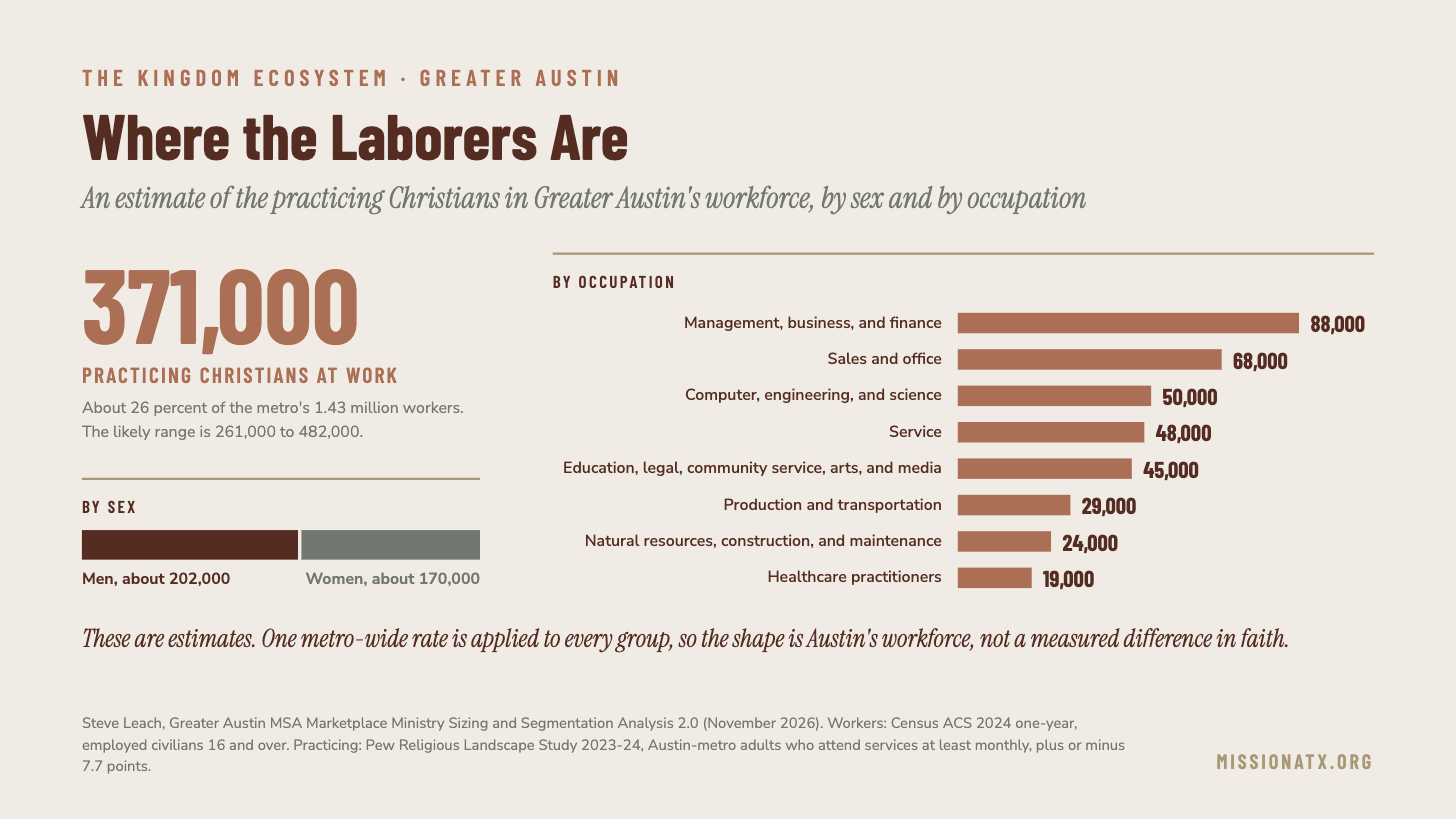
We want to be careful with this. Pew’s Austin sample is fewer than 300 people, so the real figure could sit anywhere from about 261,000 to 482,000, and the survey cannot tell us whether engineers attend church more than electricians, or women more than men. The breakdown by sex and occupation applies one rate to everyone, which means it shows the shape of Austin’s workforce and nothing more. The estimate comes from the Greater Austin MSA Marketplace Ministry Sizing and Segmentation Analysis by Steve Leach at Acacia Strategic Advisors, and we are grateful for it.
Even at the low end, the comparison is hard to miss. We count seventeen organizations in this sector, and there are at least a quarter of a million believers for them to serve.
Our Honest Read
So is faith and work in Greater Austin strong or weak?
We don’t think either word fits. The honest word for this sector in 2026 is changing, and the change is running in two directions at once.
The first direction is consolidation. ABBA’s board put its own reasoning in a single sentence: “Rather than duplicating infrastructure or competing for community resources, we believe the most faithful and impactful step forward is to consolidate our strengths.” The letter leaned on Paul’s words about one who plants and another who waters, and closed with a line worth repeating: “We are thrilled to pass the watering can.”
Ministries in our city more often fade than merge. For one of the sector’s oldest organizations to choose its own ending, publicly and gladly, so that a younger one could carry the work forward is rare, and we think it is healthy.
The ABBA decision did not happen in a vacuum. Since the spring, a group of the sector’s leaders, including representatives of the Society, has been meeting to ask whether twenty-odd organizations doing faith and work ministry in one metro could have greater impact if they worked more closely together as one body. The Society is an active supporter of this kind of collective work and is contributing to the effort, though the work belongs to the leaders in the room. What has already been seen in public is the first fruit of it, and we expect more in the new year.
The second direction is emergence, and this is the part we find most hopeful.
In the evangelism essay, we said that the most pioneering evangelists in the city right now are not in the evangelism sector at all but in the faith and work network, and promised to come back to it. Here is what we meant. Over the past two years, as we have sat with leaders across the region, a few of the younger, apostolically gifted leaders we have met have come out of this sector. They are starting things and gathering people, and they talk about making disciples in the marketplace with an energy we have not found in many other places. We won’t name them yet. Several are early in their work, and the pattern matters more than the names.
A college ministry leader who has watched seven years of students pass through told us this fall that something has shifted. For years, the students who wanted to follow Jesus and make a difference assumed that meant vocational ministry or a church residency. In the last two or three years, she has watched more of them say they will take the marketplace job and show God’s love to their coworkers there, with what she called a “non-elevated” idea of ministry.
Our experience agrees with hers. We suspect that interest in full-time vocational ministry is declining among young adults in Austin, and not only among college students. We don’t have the numbers to prove it, and we’ll be careful not to pretend we do. If the shift is real, though, then the sector that disciples believers for Monday will matter more each year, because Monday is where the laborers are going.
Changing is not a grade, and we are not giving one. The count is flat, and the sector is not. If anything, we think what is emerging here looks like strength that has not yet had time to show up in a database.
The Work
The Austin Center for Faith and Work is now both the sector’s anchor institution and its leader. It describes itself as “a growing community seeking to love God and neighbor through daily work,” and its three programs sort cleanly into the two kinds we named above. Workplace Communities connect believers inside their own companies, from prayer gatherings to employee resource groups. The 787 Fellowship is a year-long leadership program for emerging professionals, with monthly gatherings, theological training, and mentoring. Austin City Gates convenes seasoned believers to take on real challenges in and around the city. Two of those are formation, and the third leans toward mission, which is roughly the balance we see across the sector.
Every other year, the Center hosts the Faithful Work Conference with the Center for Faithful Business at Seattle Pacific University, and the next one is February 19 and 20, 2027, at Riverbend Church. The theme is Saints at Work. If you have read this far and wondered where a marketplace Christian in Austin should begin, that is our answer.
Alongside the Center sit the national ministries with an Austin chapter, which make up more than half of our count. FaithTech Austin is one of them. FaithTech describes itself as “a global community focused on stewarding our tech skills to glorify God together,” and its Austin community gathers a few times a year to meet, learn, and build together. In a metro whose economy runs on technology, a ministry that gathers Christians who write code is doing something our churches mostly haven’t.
Where to Start
If you pastor a church, how many of the people who sat in your pews this Sunday know that their Monday is ministry? Most churches have a missions committee, and almost none have a plan for the engineers. You don’t need a new program to start. Ask three people in your congregation what it is like to follow Jesus where they work, and then preach as if you had heard them.
If you lead in the marketplace, find the people in your company who share your faith. If there are more than three of you, you already have a workplace community, whether or not it has a name. The Center can help you form it, and February’s conference is a good place to meet others who have.
If you are a disciple of Jesus, what would it look like to work your job this week as if the Lord Himself had placed you there? You probably already know your coworkers’ names. Do you know what they are carrying?
To Work It and Keep It
The first thing God gave humanity to do was work. Before the fall, before any curse on the ground, the garden needed tending, and the Lord gave the task to the man He had made.
The Lord God took the man and put him in the garden of Eden to work it and keep it.
~Genesis 2:15, ESV
That is our prayer for the believers of Greater Austin who go to work tomorrow morning. The ministries in this sector are changing, and we believe God is at work in the change. We ask that the Lord raise up a generation in our city who see their desks, their job sites, and their clinics as the garden He has given them to work and keep, and that the laborers He is sending into the marketplace would find one another there.
Subscribe so the next essay, on the Christian institutions of Greater Austin, hits your inbox.
Share this with someone who has wondered whether their work counts as ministry.
Pray for the ministries of faith and work across Greater Austin, for the leaders carrying one another’s work forward, and for every disciple who goes to work tomorrow.