

The Spiritual Landscape
What Austin Believes, and What Austin Practices

We have looked at how Austin has grown, how it has changed, and where the church sits across the region. Now we come to the heart of the matter: the data that has shaped our sense of urgency more than any other. What do the people of Greater Austin actually believe? And just as importantly, how does what they say they believe compare to how they live? This is the spiritual landscape, and reading it well requires us to hold two numbers in tension that are easy to confuse.
What People Say
Let’s begin with self-identification, which is simply how people describe themselves relative to faith when asked on a survey.
Drawing on the Pew Research Center’s Religious Landscape Study, the most recent picture of the Austin metro looks roughly like this as of 2024. About 56% of adults identify as Christian. Within that, around 14% identify as evangelical Protestant, about 14% as mainline Protestant, around 3% as part of the historically Black Protestant tradition, and about 22% as Catholic. Another 8% or so identify with a faith other than Christianity. And then there is the figure that tells the deepest story: roughly 36% of Austin adults are religiously unaffiliated. Broken down, that is something like 9% atheist, 11% agnostic, and 16% who describe their religion as nothing in particular.
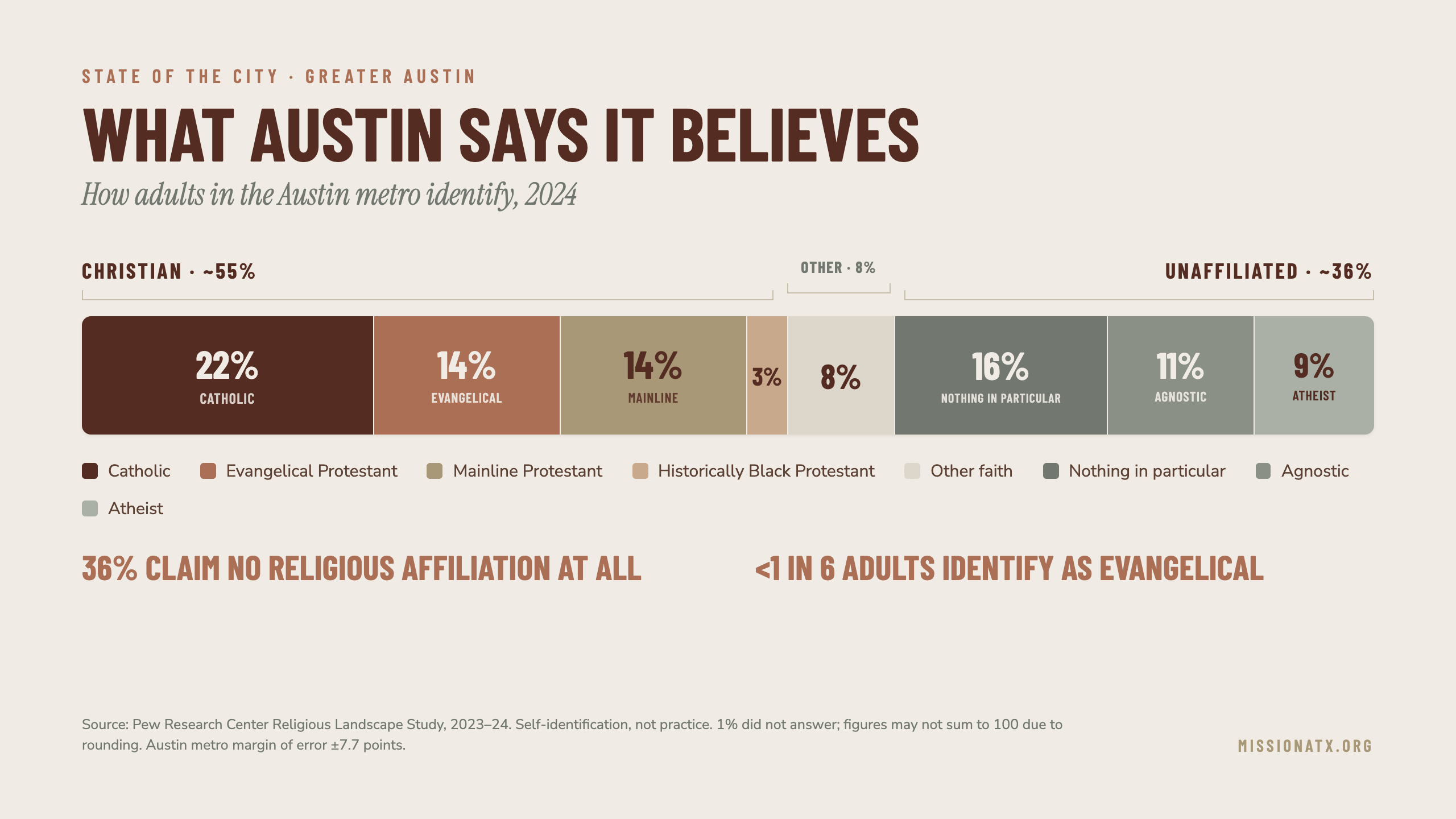
As we have sat with those numbers, two in particular stick out. Fewer than one in six adults in our metro identifies as an evangelical Protestant. And more than one third claim no religious affiliation at all. For a city in the heart of Texas, which is still very much in the Bible Belt, that is a remarkable picture. We will return in the next letter to how Austin compares to other cities, but the short version is that on the spiritual map, Austin looks less like its Texas neighbors and more like Denver or Portland. When people say “Austin is the hole in the buckle of the Bible belt” or the “blue dot in a red ocean,” they’re tapping into a reality - we’re different.
However, one honest caveat before we go on. These metro-level figures carry meaningful margins of error, often in the range of seven to nine points, because they come from surveys of a sample rather than a full count. The exact percentages will move a little depending on the study and the year. The overall shape, though, is consistent and clear, and it is moving in a definite direction.
What People Do
Here is where the most important distinction in this entire study comes into focus. Identification is not the same as practice. Saying you are a Christian and ordering your life around following Jesus are very different things, and the gap between them is enormous.
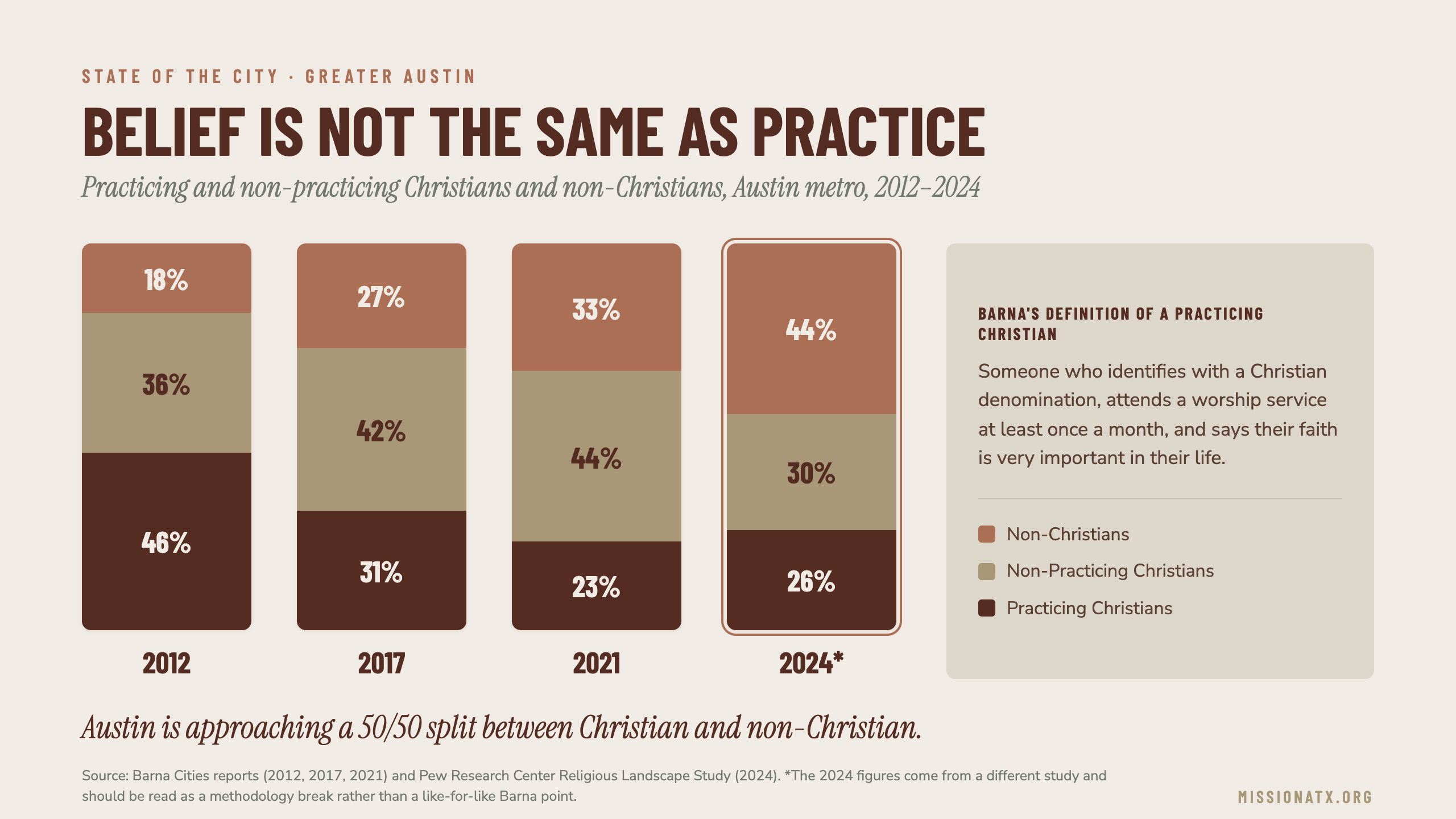
Barna offers a helpful, demanding definition here. A practicing Christian, in their framework, is someone who identifies with a Christian denomination, attends a worship service at least once a month, and says their faith is very important in their life. By that measure, the number of genuinely practicing Christians in a place is far smaller than the number who simply check the Christian box on a survey. The 56% who identify as Christian shrinks considerably when you ask not what people call themselves but how they actually live.
When you track practicing Christians against non-Christians over time, drawing on both Pew and Barna’s work, the trend lines tell a sobering story. The share of people who are practicing their faith in any meaningful, regular way has been declining, while the share of non-Christians, which Barna counts as including other faiths along with the agnostic, atheist, and no-faith population, has been climbing. The movement is rapid in Austin over a 12-year timeframe, and it is the kind of trend that compounds across a generation.
The Gap Is the Mission Field
It would be easy to read all this as bad news, and in one sense it is. But for those of us who want to think like missionaries, the gap between identification and practice is not just a discouraging statistic. It is a map of the mission field, and it points in two directions at once.
First, there is the large and growing population who claim no faith at all. These are our neighbors who are not drifting from the church because they were wounded by it, but who simply have no Christian background to drift from. For many of them, the gospel is not old news they have rejected. It is genuinely new news they have never seriously heard. That is a frontier, and it calls for the patient, curious, relational work of mission rather than the assumption that people already know the story and just need to come back.
Second, and just as significant, there is the gap inside the Christian category itself. A great many people in our region will tell a pollster they are Christian while living lives largely untouched by Jesus. This is its own kind of mission field, and in some ways a harder one, because nominal faith can be more resistant to the gospel than no faith at all. Part of the work in Austin is not only reaching those who have never believed, but calling those who believe in name into the living, practicing faith that actually transforms a life and a city.
And maybe a way of thinking about this dynamic is two-fold. First, there is not one single “Austin” - there are at least three:
Those engaged in the practice of their faith.
Those who identify in the faith but don’t participate.
Those who are in need of a faithful believer building a bridge to their different worldview.
And when it comes to demographics, there are many “Austins,” but colloquially, there are at least two - those who are largely Texan, and everyone else. This dual identity means the Church must speak two languages:
One rooted in long-standing Texan values and relational networks.
One fluent in the pluralism and complexity of a globalizing city.
The missional task, then, is to be both distinctly local and increasingly global.
A Reason for Hope, Not Despair
We do want to be careful here, though, because numbers like these can produce either despair or a kind of grim resignation, and neither belongs to the people of God. The data describes the field. It does not describe the limits of what God can do in it.
Remember that the early church was born into a world far more pagan than ours, with no cultural memory of the gospel and every structure arrayed against it, and it flourished! Remember too that the same Spirit who moved then is moving now. “I will build my church,” Jesus said, “and the gates of hell shall not prevail against it” (Matthew 16:18). A post-Christian city is not beyond the reach of that promise. If anything, it is exactly the kind of place where the gospel has always done its most surprising work. And we long for the Spirit to renew the people of God and revive us for the work that is in our midst.
What the spiritual data asks of us is not panic but presence. It asks the church in Austin to stop assuming the city is Christian and start treating it as the mission field it has become, with all the humility, patience, and hope that mission requires.
In the next post, we will widen the lens and ask how Austin compares to other American cities, because where Austin sits among its peers reveals something important about where it is headed.
Until then, would you pray for the more than a third of our neighbors who claim no faith at all, and for the many more who claim the name of Christ without yet knowing him?