

The Church Map
Denominations, Census County Divisions, and the Question of Saturation
In the last two letters, we looked at the city: how it has grown and how it has changed. Now we turn to a question much closer to our own hands at the Greater Austin Mission Society. Where is the church in all of this?
If the Lord has gathered millions of people into our region, how is his body distributed among them? This is the part of our study we have done ourselves, congregation by congregation, and it is where the data starts to feel less like a national trend and more like our own neighborhood.
How We Built the Map
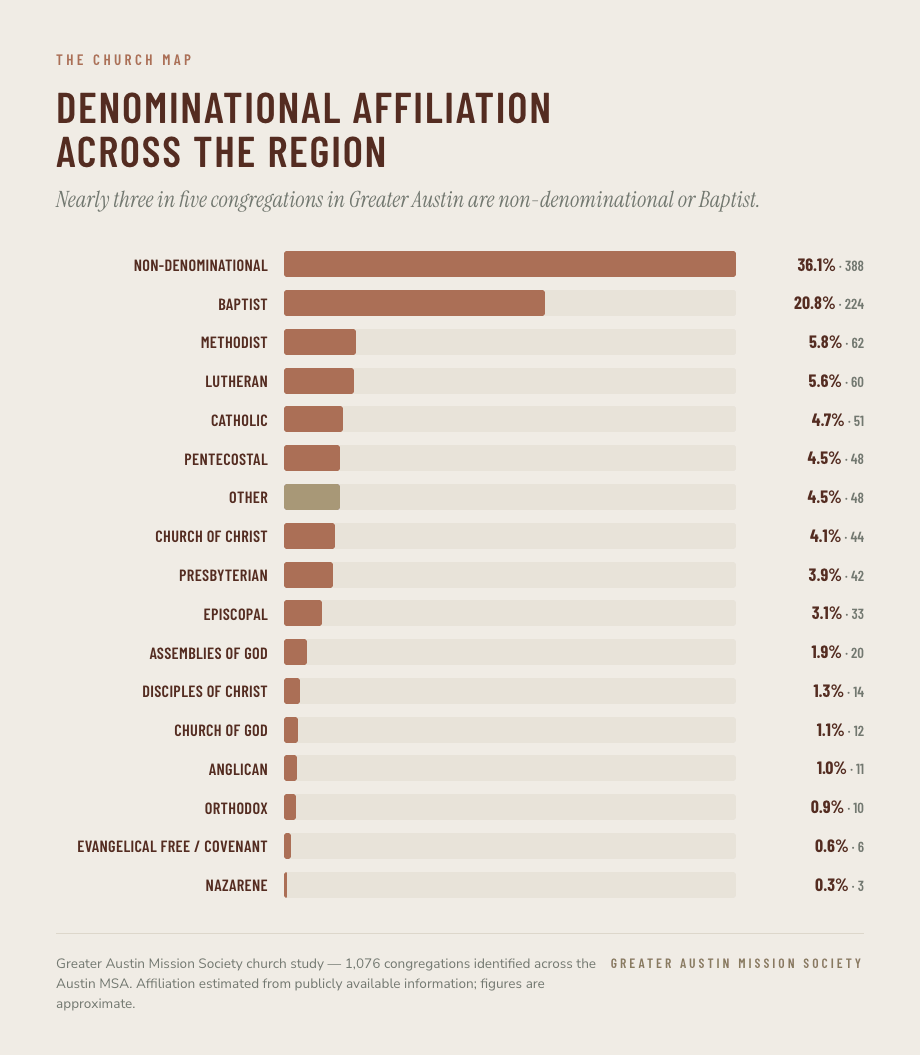
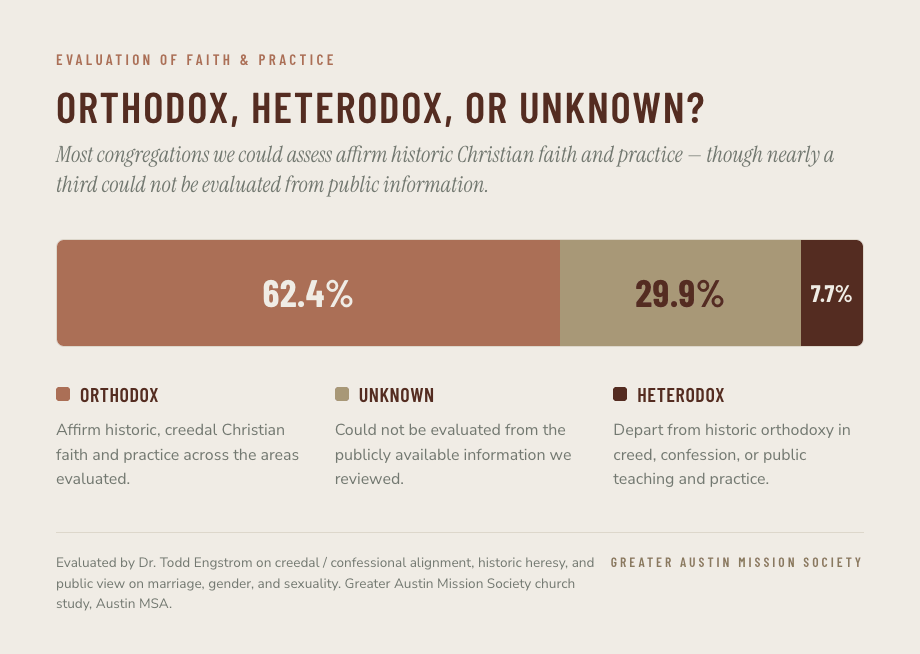
There is no single registry of churches in Greater Austin. So we built our own picture the slow way, by identifying congregations across the region and reviewing publicly available information about each one, much of it from individual church websites. From that, we have been able to estimate the denominational and theological makeup of the churches here and to locate them geographically across our region.
Let me be honest about what that means…this data is subject to error. A church website does not always tell you what a congregation actually believes or how alive it is. We have surely missed some congregations and miscategorized others. While it is imperfect, it is sufficiently accurate to reflect the overall distribution of church affiliation across the region, and it is far better than the guesswork we would otherwise rely on. We would rather show you an honest, imperfect map than no map at all.
The aim of all of it is the same: to help the church see itself, so that we can pray and partner with our eyes open.
Click the image below to access the map:

Dividing the Region to See It Clearly
A metro of two and a half million people is too large to think about all at once. So we organized our study around Census County Divisions, or CCDs, which are the distinct communities the Census Bureau uses to divide a region into recognizable pieces. Greater Austin comprises fifteen of these divisions, and each has its own character, history, and spiritual reality.
The Austin CCD in Travis County, for instance, covers more than 460 square miles. The Round Rock-Georgetown CCD in Williamson County covers about a hundred eighty-four. These are not interchangeable places. The population density, the kinds of people who live there, and the number and health of churches vary widely from one division to the next. A region that looks reasonably churched in the aggregate can contain communities where the gospel presence is thin to the point of absence.
This is exactly why we are building toward prayer guides for each CCD, which will be a major focus of this newsletter in the seasons ahead. It is one thing to pray for “Austin.” It is another to pray for a specific community, by name, knowing something true about who lives there and what the church looks like among them. Mapping the region this way is the first step toward praying for it, neighborhood by neighborhood.
The Question of Saturation
Once you can count churches and people in the same place, a harder question comes into view. How much church does a community actually need? This is the question of gospel saturation, and it does not have a tidy answer. There is no agreed-upon standard for how many churches a population requires to be meaningfully reached.
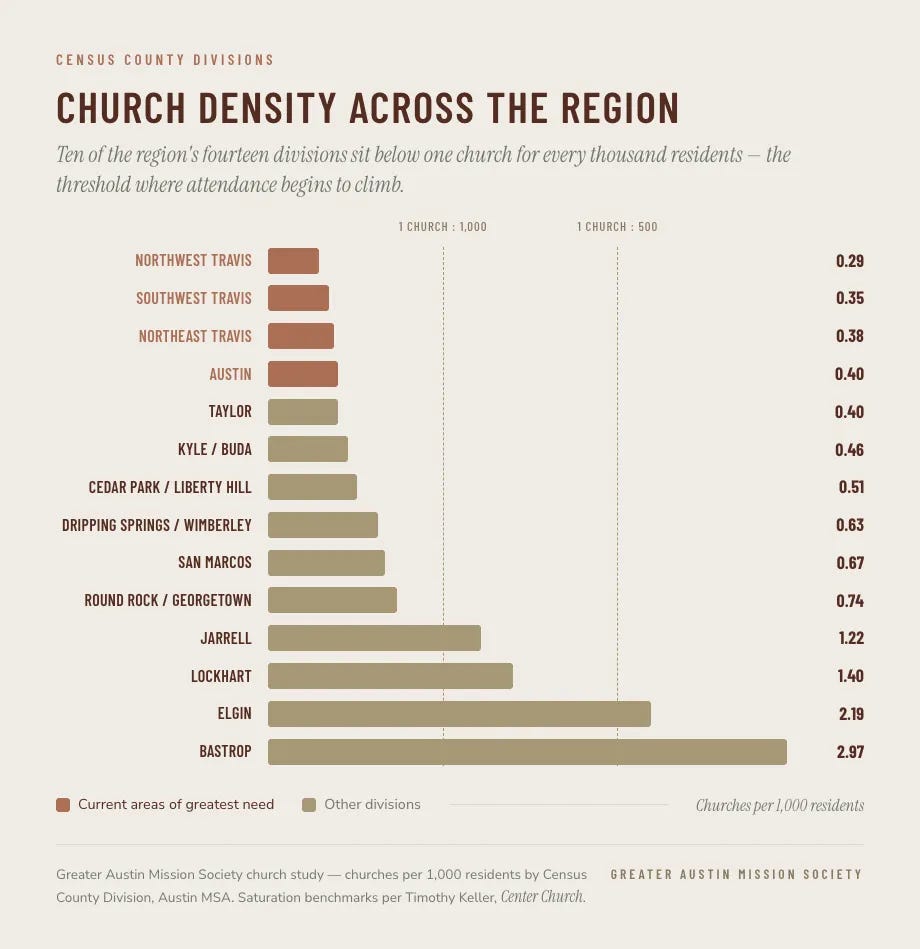
But there are useful estimates. In his book Center Church, the pastor Tim Keller offered a set of benchmarks that many have found clarifying. When a community has roughly one church for every ten thousand people, he suggested, about one percent of the population attends. When it has one church for every thousand people, attendance tends to rise to something like fifteen to twenty percent. And when it reaches one church for every 500 people, more than 40% of the population attends.
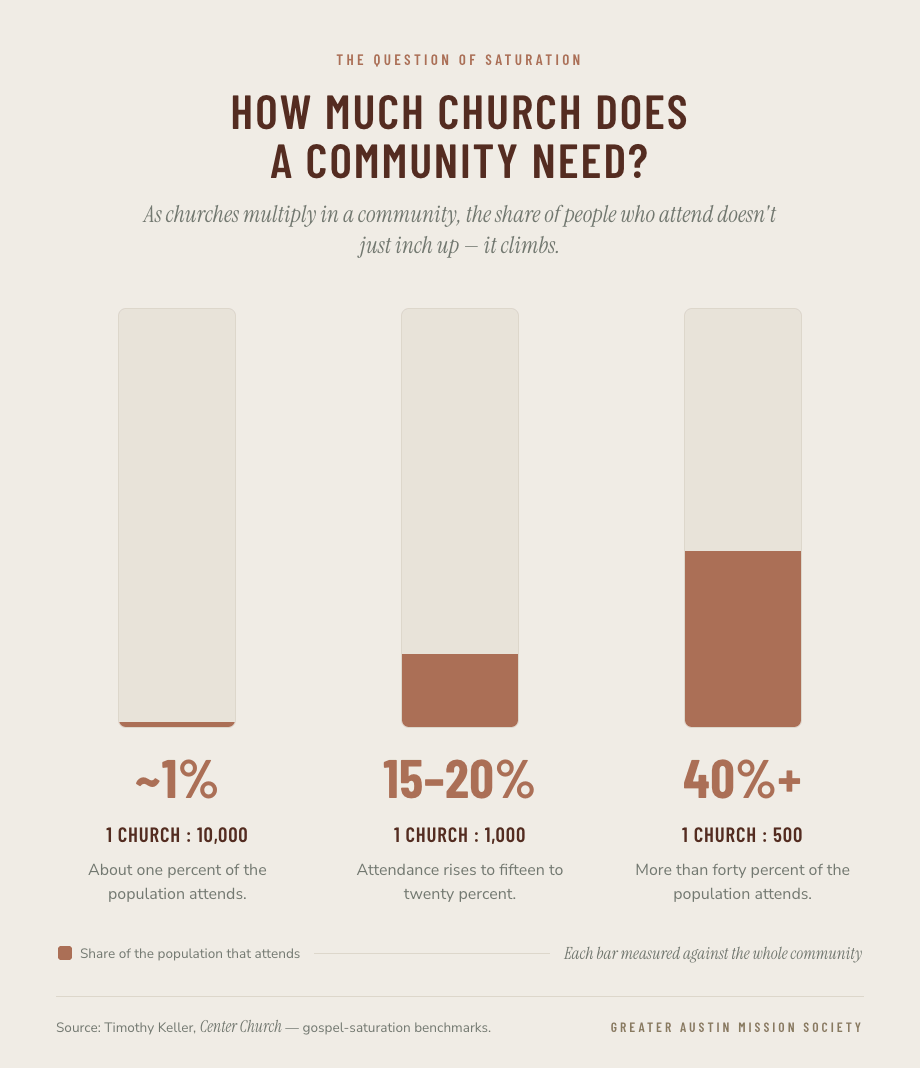
Notice what those numbers imply. The relationship between churches and attendance is not flat. Beyond a certain density, the presence of more healthy congregations seems to lift the spiritual engagement of an entire community, not just fill more seats. Saturation is not about competition between churches. It is about a community reaching a threshold at which the gospel becomes a visible, accessible, and ordinary part of life rather than a rare exception. A neighborhood with one struggling church for many thousands of residents is a very different mission field from one where congregations are woven through daily life.
We are still doing the ongoing work of comparing church counts to population across each CCD, and we will share what we find as things change. But even the early picture makes one thing clear. Greater Austin is not uniformly reached. There are communities in our own region where, by any reasonable benchmark, the church is stretched thin, and the people there are no less precious to God for living where the gospel is scarce.
What This Asks of Us
It would be easy to read a saturation benchmark as a building program: plant more churches, raise the ratio, declare victory. But the gospel is not finally about ratios, and Keller’s numbers are a diagnostic, not a destiny. They help us notice where the church is present and where it is absent. What we do with that noticing is a matter of prayer, wisdom, and partnership, and it will look different in a dense urban core than in a fast-growing suburban division.
What the map asks of us, first, is honesty. It is tempting for those of us inside healthy, well-resourced churches to assume the whole region looks like our corner of it. The data quietly corrects that assumption. The body of Christ in Greater Austin is real and active, yet unevenly distributed across a region that has grown faster than the church has been able to keep pace with.
Jesus, “when he saw the crowds, had compassion for them, because they were harassed and helpless, like sheep without a shepherd” (Matthew 9:36). His response was not first a strategy but a prayer: that the Lord of the harvest would send out laborers. That is where an honest church map should lead us. Not to anxiety about numbers, and not to pride about our own congregations, but to compassion for the communities where the shepherds are few.
In the next letter, we move from the church to the wider spiritual landscape, and to the most important distinction in this whole study: the difference between what people say they believe and how they actually live. Until then, would you pray for the communities of Greater Austin, where the church is thin, and ask the Lord of the harvest to send laborers there?