

Austin Among Its Peers
Why Our City Looks More Like Denver Than Nashville


When I arrived in Austin in the early 2000s, the prevailing narrative was that this was a lost city, a church-planting graveyard. And this is one of those “stories from a long time ago,” but it always drove me nuts that we compared Austin to San “Fransisco” in a video we created…typos are my nemesis. If you find one in these posts, let me know!
The reality on the ground was closer to the opposite, however, based on the research of the past few years. Austin was still in most ways a Southern city with a Southern church culture. It was a little weirder than its neighbors, but cut from the same cloth from a mission perspective. Then the last fifteen years happened, and the city changed fast enough to catch up to its own reputation. I’ve honestly wrestled with the question of manifest destiny here…whether we simply became what everyone said we already were.
Whatever the answer, considering Austin as fundamentally Southern no longer fits. We have hinted at this twice in the series already: with a spiritual lens, Austin looks less like its Texas neighbors and more like Denver or Portland.
This letter is where we show the numbers behind that claim, because to understand where Austin might be headed spiritually, the most useful thing we can do is look at the cities it actually resembles. And they’re probably not the ones most people would guess.
Why Compare at All
As GAMS develops its research and strategy, two questions keep surfacing.
Which cities are most like Austin?
And which organizations are doing similar gospel work in those places?
The first question matters because a peer city is in some ways a window into the future or a mirror of the present. If a city further along the same path can show us what is coming, we can prepare rather than merely react. The second question matters because we don’t want to reinvent what faithful people elsewhere have already learned. We would rather build on their wisdom.
To quote my friend and colleague Steve Verleye, “The only thing worse than reinventing the wheel is reinventing the flat tire.”
So we profiled eight peer metros, drawing spiritual data from the Pew Research Center’s 2023-24 Religious Landscape Study. We have been honest in earlier letters about numbers, and the same caution applies here: metro-level figures carry margins of error of roughly seven to nine points, and for two cities not covered at the metro level, Raleigh-Durham and Kansas City, we used state-level data as a noted proxy. Those are approximations, and we know it.
The comparisons below are directional rather than precise, but the pattern they reveal is pretty clear.
The Austin Baseline
To compare Austin, you first have to fix where it stands, and the last letter did that for us. By the most recent Pew data, the Austin metro is about 55% Christian, with evangelical Protestants at 14%, mainline Protestants at 14%, historically Black Protestants at 3%, and Catholics at 22%. The religiously unaffiliated make up about 36%, split among atheists at 9%, agnostics at 11%, and nothing in particular at 16%.
Fewer than one in six Austin adults identifies as evangelical Protestant.
If you can, hold these anchors in mind as we travel: 36% unaffiliated, 14% evangelical. Now compare.
The Cities Austin Actually Resembles
Denver is Austin’s closest structural analog. It is a state capital with a major research university and a tech-driven wave of in-migration, just like Austin, and its spiritual profile tracks closely: around 53% Christian and 39% unaffiliated. Its evangelical share is even lower than Austin’s, at about 10%. If you want to know what a city shaped by the same forces as Austin looks like, look at Denver.
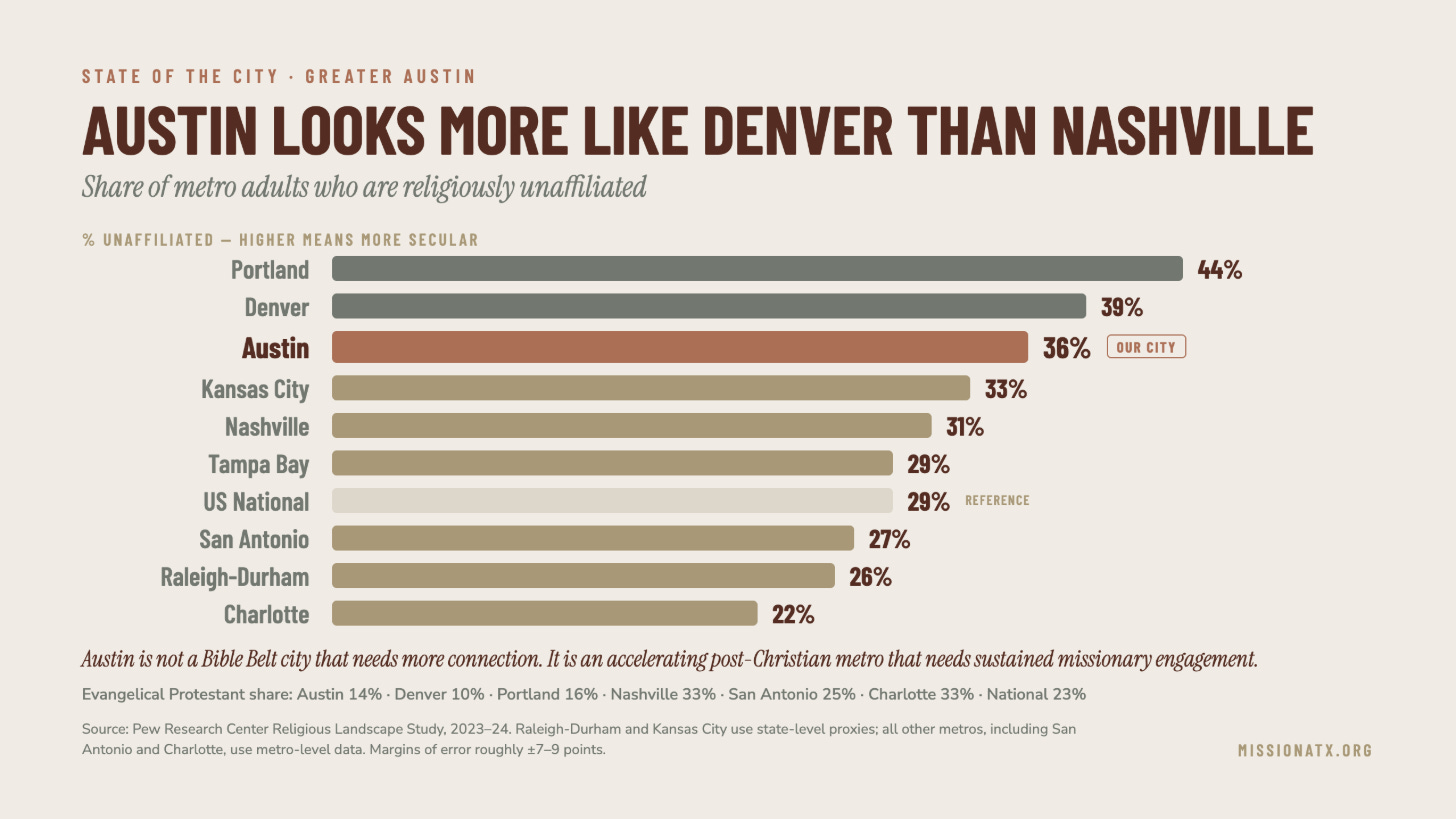
Portland is the closest match in raw population, and it is the most secular large metro on our list. Christians there are a minority at about 42%, and the unaffiliated have climbed to 44%. We have come to think of Portland as something like a ten-to-fifteen-year forward projection of Austin’s trajectory. It’s not a warning so much as a preview, a picture of where the present trend leads if it simply continues.
The City Austin Is Assumed to Resemble
Then there is Nashville, the city Austin is most often compared to culturally, and here the gap is widest. Spiritually, Nashville and Austin are not alike at all. Nashville is about 63% Christian with an evangelical share of 33%, more than double Austin’s 14%. By our read, Austin is roughly eight to ten years ahead of Nashville in secularization. The two cities may share a music scene and a certain creative-class energy, but they are on different points of a very different spiritual curve.
The Twin Down the Highway
Then there is the comparison that should be the easiest of all and turns out to be informative. San Antonio sits eighty miles down I-35, nearly our exact population match at 2.8 million against Austin’s 2.6 million, sharing the same state, the same interstate, and much of the same demographic makeup. If proximity and size predicted spiritual character, the two cities would be the same story told twice.
They are not.
San Antonio is about 70% Christian, with an evangelical share of 25%, nearly double Austin’s, and a Catholic population at 29%, well above Austin’s 22%. Its unaffiliated share sits at 27%, nine points lower than ours. San Antonio is a Bible Belt city. Austin, eighty miles up the same road, is not.
Whatever is driving Austin’s secularization, it is not simply Texas, or size, or growth, because our nearest twin has all three and looks nothing like us.
Charlotte deserves more than a passing mention too, because it complicates the story in an interesting way. It is growing at nearly Austin’s own pace, drawing much of the same wave of finance and tech relocation, and yet it is the most churched city in our entire comparison set: about 73% Christian, with an evangelical share of 33% and a historically Black Protestant tradition at 14%, the strongest of any metro we studied. Only 22% of Charlotte adults are unaffiliated. We are not holding Charlotte up to shame Austin. We are holding it up because it proves a city can absorb Austin’s kind of growth without following Austin’s kind of drift, and that is a picture worth aspiring to. And we’re learning a lot from For Charlotte, who paved a way in this kind of work.
The rest of the comparison set fills out the picture. Raleigh-Durham is the fastest-growing metro on our list, but North Carolina’s Christian identification has fallen 16 points since 2007, so it is worth watching as another city in motion.
Tampa Bay sits close to national averages and is more churched than Austin.
Kansas City is a more complicated read. It carries a healthier church-to-population ratio and an evangelical share around 31% statewide, more than double Austin’s, yet the same statewide numbers put its unaffiliated share at about a third, a reminder that no city on this list is standing still. For reference, the national figures are about 62% Christian, 29% unaffiliated, and 23% evangelical, which means Austin is meaningfully less churched than the country as a whole.
What This Framing Changes
This may seem like an academic exercise, sorting cities into categories. But the peer comparison fundamentally reframes the work in front of us, and it changes how we ought to pray, plan, and partner.
If Austin were a Bible Belt city, the ministry task would mostly be one of connection: linking together the many existing churches and the broadly Christian population, sharpening what is already strong.
But Austin is not that city. And that strategy has been tried already here.
At 36% unaffiliated and 14% evangelical, it is closer to Denver or Portland than to Nashville. That means the task is not primarily connection. It is mission. Austin is not a Bible Belt city that needs more coordination. It is an accelerating post-Christian metro that needs urgent and sustained missionary engagement. Naming that accurately is the difference between a strategy that fits the city and one built for a city that no longer exists.
We are not the first to face this. In Portland, an organization called TogetherPDX is doing citywide gospel work in a context even more secular than ours, modeling what ministry looks like in genuine adversity. In Nashville, Together Nashville is gathering leaders across traditions around the prayer of John 17 and shares data about the church of their city in a way strikingly similar to our own hopes. In Denver, the Denver Institute for Faith and Work has built perhaps the most intellectually developed ministry to a professional-class city like ours and has shaped the Austin Center for Faith and Work. We count them as companions on the same road, and several of them are already connected through wider networks of city gospel movements. We have much to learn from them, and we intend to.
The Honest Bottom Line
Austin is a beautiful, growing, creative city that the Lord clearly loves, because he has gathered so many people into it. It is also, by the clearest measures we have, a post-Christian metro moving steadily further from the faith, more like the secular cities of the West than the churched cities of the South. To love it well, we have to see it as it actually is, not as the Texas of our imagination, or the Texas of history. It is something new and different.
That clarity is not cause for fear, but warrant for the kind of faith that took the gospel into Athens and Corinth and Rome. These cities were far less Christian than ours, and God’s Word bears witness that He will build his church there anyway.
In the final letter of this series, we will ask the question the whole study has been driving toward. Given all of this, what is the data asking of the church in Austin, and what does it ask of you?
Until then, would you pray for the cities on this list and the believers laboring in them, and for an Austin church willing to see itself clearly?
More soon.
 |
|