

A City Transformed
Population Growth and the Changing Face of Austin


If you have lived in Greater Austin for any length of time, you do not need a chart to tell you the city has changed. You feel it in the traffic, in the cranes on the skyline, in the names of neighborhoods that did not exist when you arrived, in the prices of homes that once seemed ordinary. But feeling a change and understanding it are different things, and one of the gifts of careful data is that it lets us trace the exact shape of what we have only sensed. So let us look at the numbers, because they are part of how God is teaching us to see this place.
A City That Doubled
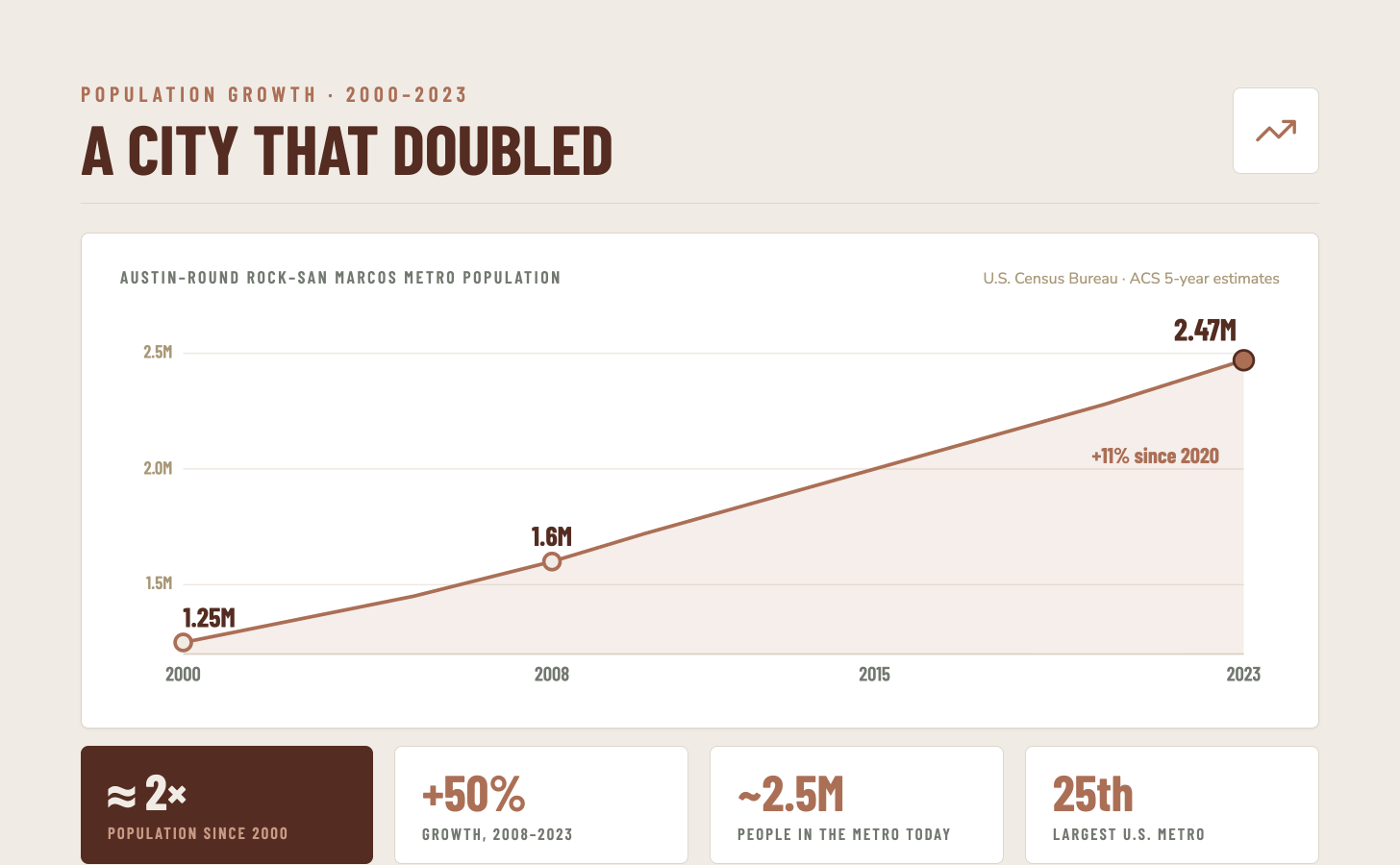
Start with the simplest fact. Between 2008 and 2023, the Austin-Round Rock-San Marcos Metropolitan Statistical Area grew by more than fifty percent. Step back further, and the picture is even more striking: since the year 2000, the metro has roughly doubled in population. Today the region is home to somewhere around two and a half million people, which makes it the twenty-fifth largest metro in the country, and it is still growing, up about eleven percent since 2020 alone.
It is hard to overstate what that kind of growth does to a place. Doubling is not the same as getting bigger. A city that doubles becomes, in many respects, a different city. The institutions built for the old population, the churches and schools, and civic structures, were sized and shaped for a community that no longer exists. Much of what we will explore in this newsletter traces back to this single, stubborn fact: Austin grew faster than its institutions, including its churches, could adapt.
Growth on this scale is not a problem to be solved. It is a mission field arriving at our doorstep. Every year, hundreds of thousands of people move into this region carrying their own histories, hopes, wounds, and questions. Most of them are not coming to church. Many have never been. The Lord has gathered the nations into our metro, and the question for the church is whether we will see them.
A Changing Face
Growth is only half the story. The other half is who is doing the arriving, because Austin has not just grown larger. It has grown different.
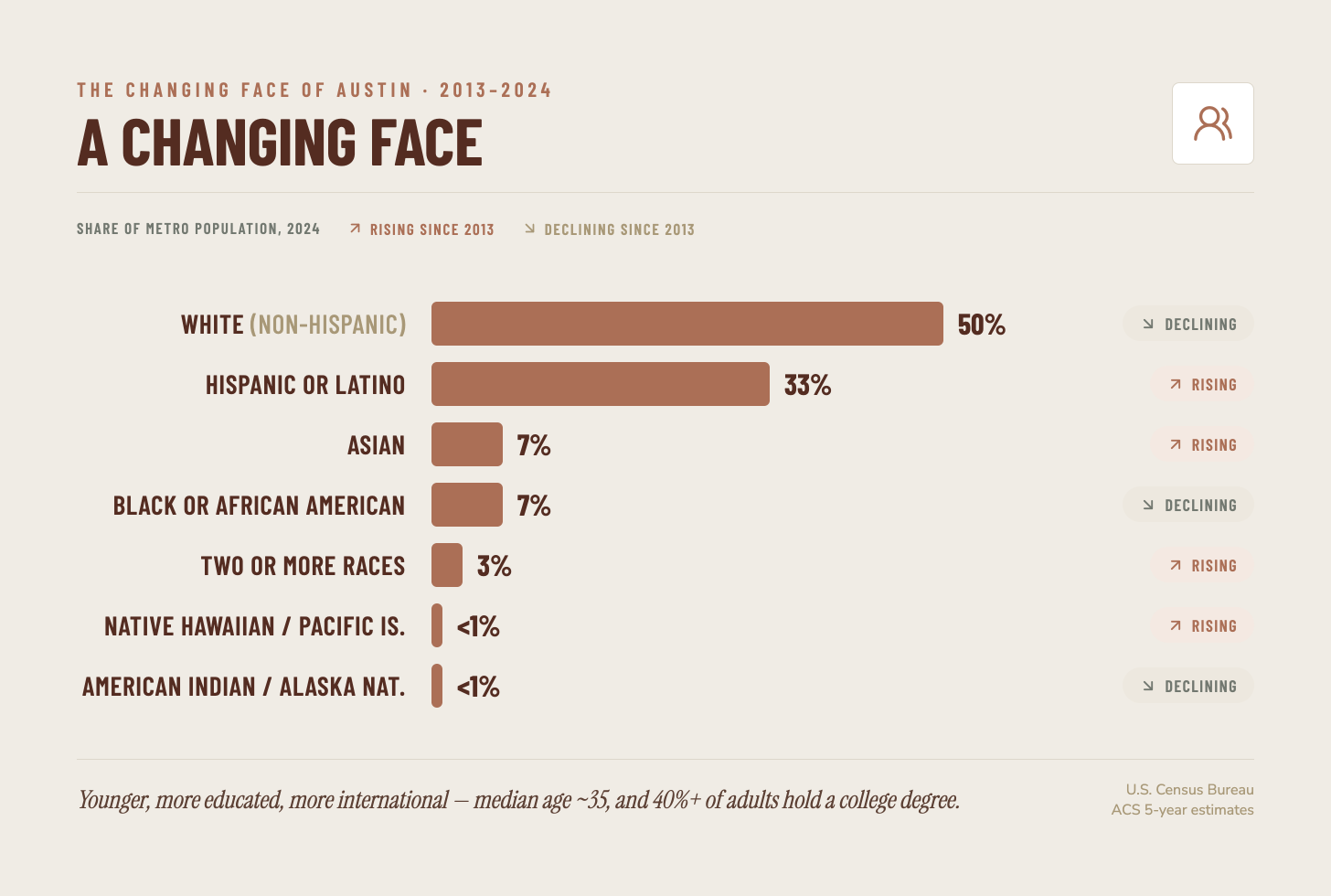
Between 2013 and 2023, the region's ethnographic makeup shifted in clear directions. The share of residents identifying as White, as Black or African American, and as American Indian or Alaska Native each declined. At the same time, the share identifying as Asian, Native Hawaiian or Pacific Islander, Hispanic or Latino, and more than one race each increased. In the most recent estimates, the metro is roughly half White (non-Hispanic), about a third Hispanic or Latino, around seven percent Asian, and around seven percent Black, with a median age near thirty-five and more than forty percent of adults holding a college degree.
Read those numbers slowly, because each one is a face. Austin is younger, more educated, more international, and more multiethnic than it was a generation ago. It is anchored by technology, government, and higher education, which means it draws ambitious, mobile, often skeptical people from across the country and the world. These are not the demographics of a settled, churched community. They are the demographics of a frontier.
What the Numbers Ask of the Church
For those of us who long to see Austin reached, this picture cuts two ways.
On the one hand, it is an extraordinary opportunity. The Great Commission sends the church to “all nations,” and in a real sense, the nations have come here. The diversity of language, culture, and background that missionaries once crossed oceans to reach now lives down the street. A church that learns to love its actual neighbors in this city is, without leaving home, participating in God's global mission.
On the other hand, it is a sobering challenge. A church culture built for a slower, more homogeneous, more nominally Christian Texas will not automatically connect with the city that has replaced it. Ministry strategies that worked when most newcomers already had a church background do not reach those with none. Reaching this Austin requires the patience, curiosity, and humility of cross-cultural mission, even when the city in question is the one we call home.
The Apostle Paul, writing to the Athenians, did not begin with condemnation. He began with attention. He had walked the city, observed its objects of worship, and even quoted its poets, and from that careful seeing he proclaimed the God who “made from one man every nation of mankind to live on all the face of the earth, having determined allotted periods and the boundaries of their dwelling place” (Acts 17:26). The God who set the boundaries of the nations also set the boundaries of our metro, and the people he has gathered here are no accident.
Holding This Honestly
A word on the data itself. These figures come from the Census Bureau’s American Community Survey five-year estimates, which are among the most reliable population measures available, though they are estimates and not a perfect count. The broad direction, however, is not in doubt. Austin has grown dramatically and diversified meaningfully, and both trends show every sign of continuing.
In the next letter, we turn from who lives here to a question closer to our own work: where is the church in all of this? We will lay out what our study of congregations across the region revealed, and what it suggests about how thoroughly the gospel has taken root across Greater Austin.
Until then, would you pray for the hundreds of thousands the Lord has gathered into this city, and for a church awake enough to see them? And if these letters are helping you see Austin more clearly, share this one with someone who would want to see it too.